
Introduction
In the traditional business model, scaling technical operations meant choosing between two evils: a massive hiring spree for a costly in-house team or a desperate scramble for inconsistent freelancers. By 2026, both paths are showing their age.
In-house hiring cycles are often too slow and cost-prohibitive for growing organizations, while the “freelancer lottery” creates a critical reliability gap that stalls long-term digital transformation. At Oisulli Tech Labs, we operate precisely at the intersection of engineering precision and business strategy. We’ve seen firsthand that the secret to scaling isn’t just adding headcount—it is mastering strategic outsourcing. When you leverage specialized virtual assistance for technical operations, you aren’t just offloading tasks; you are engineering a scalable digital system that yields a true competitive advantage.
What is Technical Strategic Outsourcing? (Featured Snippet)
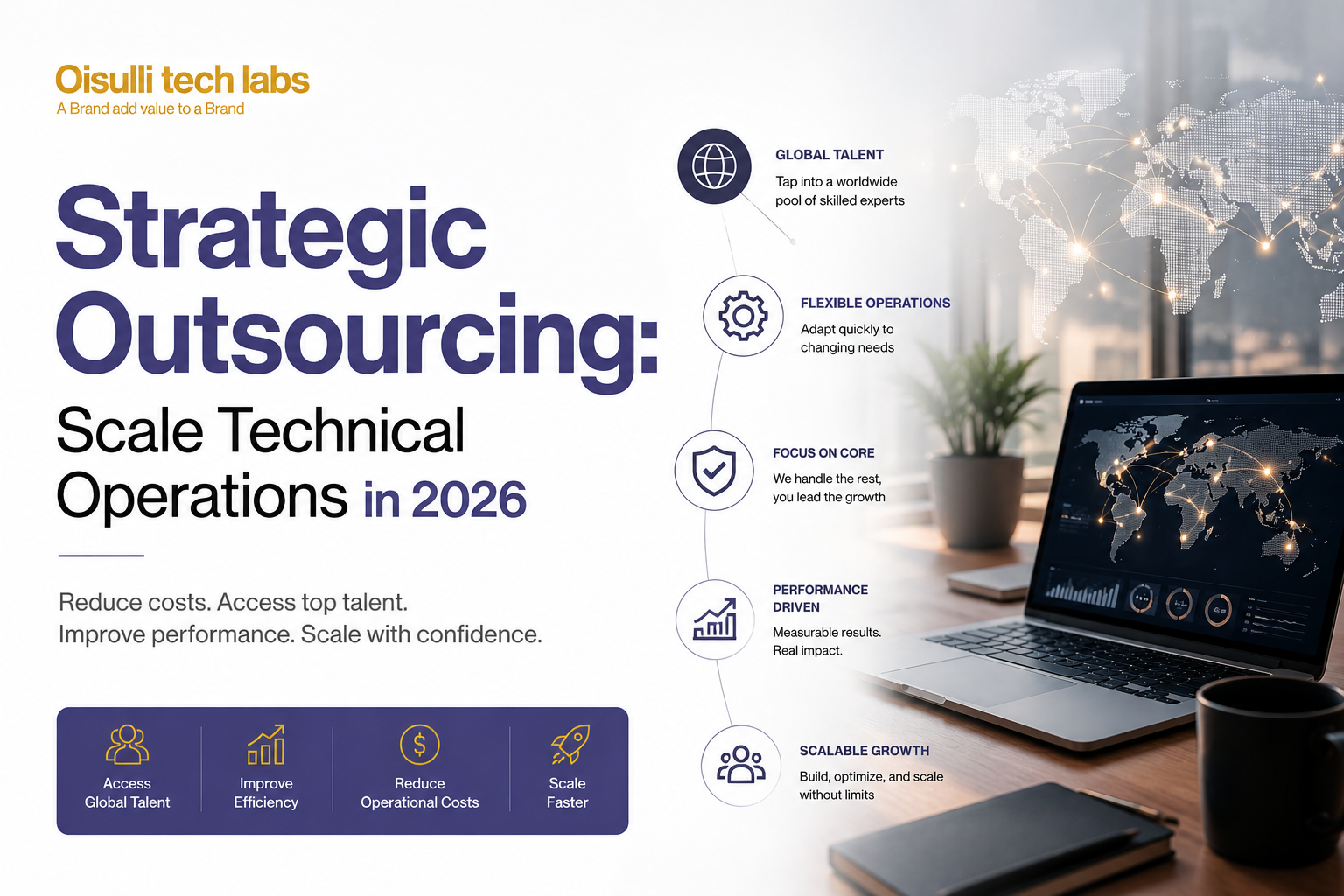
Strategic outsourcing in technical operations is the practice of delegating specialized digital tasks—such as pipeline engineering, data analytics, and UI/UX design—to an external team of experts rather than generalist virtual assistants. This approach ensures businesses build scalable infrastructure, improve operational efficiency, and minimize overhead while maintaining high performance.
- Breaking the “Generalist” Illusion
🛑 THE REALITY CHECK
Most business blogs hand out the same generic advice: “Hire a Virtual Assistant to clear your inbox.” But for a technical organization, treating a VA as a catch-all solution is a fast track to a “Data Without Direction” trap.
If an assistant doesn’t know the structural difference between a CMS integration and a complex hosting configuration, they aren’t scaling your operations. They are increasing your managerial oversight burden and creating an expensive operational bottleneck.
The Technical Operations Advantage
Instead of chasing generalist tasks, forward-thinking companies scale by securing specialized talent. Under a structured framework, virtual technical operations handle deep data audits, pipeline designs, dashboard development, and advanced KPI tracking.
Furthermore, these specialists do not just patch software or fix immediate, isolated bugs. They work intentionally within an established enterprise IT architecture, ensuring every small micro-change is fundamentally built for long-term scale.
- The Oisulli Framework: Diagnosis Before Delegation
One of the core differentiators of Oisulli Tech Labs is our absolute commitment to diagnosis before solution. This philosophy applies heavily to strategic outsourcing. Most businesses fail when delegating operations because they outsource superficial symptoms (e.g., “Our site is slow”) instead of solving the underlying technical issues (e.g., “The backend architecture is not forward-compatible”).
To fix this, we utilize a three-phase modular delegation process:
[ PHASE 1: The Tech Audit ] ──> [ PHASE 2: Scoped Deliverables ] ──> [ PHASE 3: Contractual Guardrails ]
Phase 1: The Technology Audit
Before you bring anyone onboard, you must run a comprehensive audit to uncover your “invisible liabilities.” This means identifying outdated digital presences, security loopholes, or fragmented brand identities.
Phase 2: Scoping the Exact Deliverable
Never ask an outsourcing partner to simply “manage the tech.” Instead, assign precise, measurable milestones. A clear example: “Deliver a custom-designed website with mobile-responsive layouts and proper SEO structure.”
Phase 3: Enforcing Contractual Accountability
Outsourcing only feels risky when boundaries are blurry. Every engagement must be governed by formal agreements that detail exact project scopes, strict timelines, and clear revision limits to protect your investment.
- The Architecture of Integrated Solutions
The Oisulli approach emphasizes absolute integration over isolation. When you outsource technical operations pieces by piece to disconnected providers, you introduce the massive risk of siloed work—a frustrating loop where your visual branding doesn’t match your web development, which completely fails to align with your core data strategy.
How We Build System Intelligence
Cross-Service Coherence: Your virtual technical operations must be designed so that core brand identity explicitly informs website design, and raw data strategy directly informs high-level consulting recommendations.
Unified Documentation: Never let the “brain” of your business get stuck inside one person’s head. Demand a complete documentation package and clean knowledge transfer upon project completion so the intelligence lives safely within your company systems.
Global Architecture: Utilizing a remote-first model allows organizations to support technical operations seamlessly across Africa, Europe, North America, and the Middle East, scaling workflows 24/7 without a reduction in service quality across time zones.
- The Hard Metrics: Measuring Your Outsourcing ROI
We measure professional work by business outcomes, not hours logged on a timesheet. Technical operations outsourcing is a direct financial investment, and it must produce measurable performance improvements to be considered a success.
70% Time Recovery: By implementing automated data analytics pipelines, manual reporting time has been slashed by an average of 70% for client operations teams.
40% Conversion Growth: Moving away from generic templates to professional, conversion-focused websites can increase qualified lead generation by 40% in as little as three months.
Rapid Leadership Reviews: Transitioning from assumption-based operations to evidence-based analytics allows leadership to run weekly reporting reviews in under an hour rather than losing two days to spreadsheets.
- Scalability Playbooks: Matching Your Growth Stage
Scaling a business isn’t linear. A startup launching a new digital product has entirely different infrastructure needs than an established enterprise modernizing legacy systems. Finding the right fit requires selecting the appropriate tactical playbook:
The Blueprint Playbook (Fixed-Scope Project)
Best for one-time, highly defined needs. This includes foundational updates like brand identity creation or a single analytics dashboard setup. It offers clear boundaries and fixed pricing.
The Evolution Playbook (Phased Delivery)
Ideal for complex web applications or massive digital transformations. This model gives you the flexibility to scale and adjust the technical scope as milestones are hit.
The Engine Playbook (Retainer Agreement)
Perfect for continuous monthly support. This ensures you have reliable, ongoing technical mastery over design updates, security patches, and pipeline maintenance.
Frequently Asked Questions (FAQ)
Q: How do I know if my business is ready for technical outsourcing?
A: If your leadership team is spending more time fixing software bugs, managing hosting problems, or wrestling with data spreadsheets than focusing on core business growth, you are ready to outsource.
Q: What is the risk of hiring a generalist assistant for technical tasks?
A: A generalist lacks the deep engineering background required to build secure, scalable systems. This usually results in fragmented workflows, security vulnerabilities, and code that needs to be completely rewritten later.
Q: How does Oisulli ensure consistency across branding and development?
A: We eliminate communication gaps by keeping our designers, developers, and data strategists under one unified framework, ensuring your visual identity blends seamlessly with your software architecture.
Conclusion: Trade Symptoms for Systems
Strategic outsourcing is not about finding cheap, temporary labor; it is about securing a specialized technology partner. It is about closing the massive gap between the technology that exists and the precise expertise required to apply it correctly to your business goals.
Don’t let your operational potential get lost in the dark. Trade chaotic guesswork for structured systems, eliminate technical bottlenecks, and make the operational decisions that actively drive revenue growth.
Ready to Lead with Absolute Confidence?
Stop managing symptoms. Start building a system designed to scale.
[👉 Book Your Strategic Discovery Call with Oisulli Tech Labs Today]